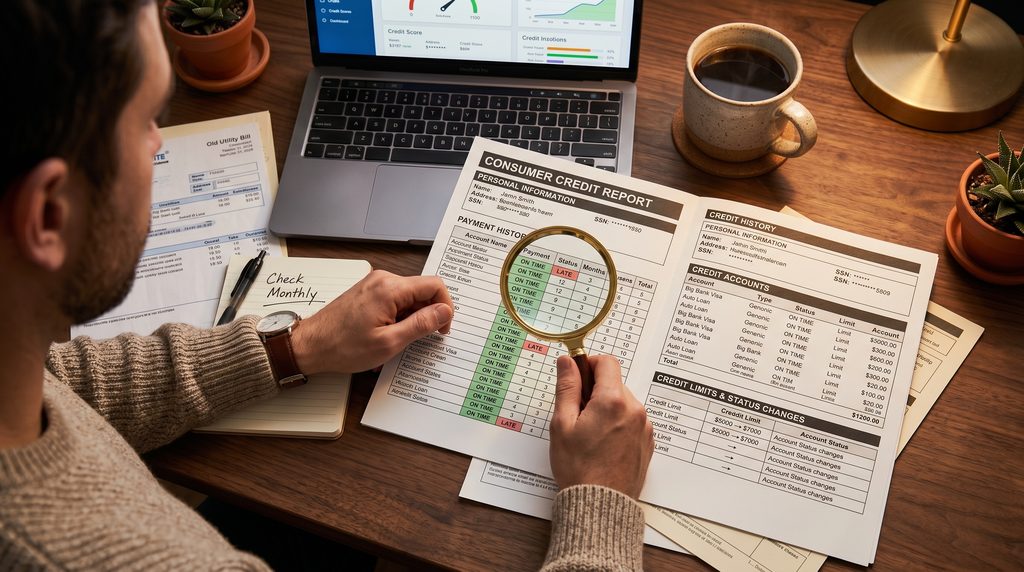
You’re probably only used to reviewing your credit report when you want something from it. Perhaps you’re applying for a mortgage. Or you have your eye on a new credit card. And you’ll definitely need to check in on your credit history when you’re financing a car.
If you think that’s enough, you’re mistaken. Your credit report isn’t frozen in carbonite like Han Solo. It’s a living record of your credit activity. That means checking it regularly can help you catch potential issues before they become big problems.
Your credit report isn’t frozen in carbonite like Han Solo. It’s a living record of your credit activity.
You don’t need to whip out the magnifying glass or the lightsaber to parse through every line of your credit report. Spending a few minutes every month allows you to spot errors, recognize potential fraud and get a clearer sense of what’s happening with your credit.
Try scanning your credit report for these five items every month.
Sponsored by Sky Blue Credit is the most powerful solution to dispute errors on your credit reports, rebuild your credit, and optimize your scores.
1. Your Personal Information
Checking the basic information attached to your credit report, such as your name, addresses and other identifying information, may seem simple. It’s still incredibly important.
An old address isn’t necessarily a problem. People move, and credit reports can contain information from your previous addresses. But if you see information that you don’t recognize at all, it’s worth taking a closer look.
Unexpected personal information could come from a reporting error. In some cases, it could be a clue that someone who definitely isn’t you has used your identity.
2. Any Unfamiliar Activity
Start with the most important question: Are all of the accounts on this credit report actually yours?
Start with the most important question: Are all of the accounts on this credit report actually yours?
It seems like a silly question. But answering it early can mean the difference between clearing up a minor issue and dealing with a more serious hit to your credit down the road. An unfamiliar account could be a simple mistake, such as an account being reported under the wrong name. But it could also be a sign that someone has opened an account using your personal information.
Look through the accounts listed on your credit report and make sure you recognize each one. Pay particular attention to accounts you don’t remember opening, especially newer ones.
You should also scan for credit inquiries you don’t recognize. If you see a hard inquiry from a lender or creditor you don’t recognize, it’s worth contacting the credit bureau that reported it.
Sponsored bySky Blue Credit is the most powerful solution to dispute errors on your credit reports, rebuild your credit, and optimize your scores.
Checking for unfamiliar activity every month could prevent you from getting an unfortunate surprise when you need a loan or want a credit card application to go smoothly.
3. Your Account Balances
Once you’ve established that all the activity in your report is accurate, take a look at the balances being reported on your credit cards and other revolving accounts.
Ask yourself two key questions: Do they look familiar? Do they roughly match what you’re carrying?
Your credit report isn’t necessarily a real-time snapshot of your balances. Creditors typically report information to the credit bureaus on their own schedules. That means the balance on your report might be different from what you see when you log into your account. And that’s generally okay.
However, large or unexpected differences are worth looking into.
Your reported credit card balances also matter because they contribute to your credit utilization ratio, which compares your revolving balances with your available credit. A high utilization ratio can affect your credit scores even if you’re making your payments on time.
Doing a monthly check can help you see what lenders and scoring models are actually seeing instead of relying solely on the balance displayed in your credit card app.
4. Your Payment History
If you’ve consistently made your payments on time, first off, congratulations. That’s definitely worth celebrating. You certainly want your credit report to reflect that, and not just because it’s a lot of hard work (though it is).
Payment history is an important part of your credit profile, so an inaccurate late payment could have consequences beyond simply being an annoying error on a report.
It’s also useful to look for accounts that have recently changed status. If an account you thought was current suddenly shows a late payment or delinquency, don’t ignore it. Gather your payment records and dispute it with the bureau reporting it.
Sponsored bySky Blue Credit is the most powerful solution to dispute errors on your credit reports, rebuild your credit, and optimize your scores.
5. Changes to Your Credit Limits or Account Status
While you’re reviewing your credit report with a cup of hot coffee, tea or perhaps something stronger, you should also look for any changes to existing accounts. Specifically, check whether your credit limits, account status or other major account details look correct.
You might notice that an account has been reported as closed when you’re pretty sure it’s still open, or that a credit limit is different from what your creditor told you.
Why does this matter? Changes to your credit limits can impact your credit utilization. If your balance stays the same but your available credit decreases, your utilization ratio could increase.
Also, an account incorrectly reported as closed, delinquent or otherwise changed could affect how your credit history is evaluated. You don’t want that.
No, you don’t have to memorize every detail of every account, but you should watch for changes that don’t make sense.
Make Your Credit Report a Monthly Habit
Checking your credit report every month doesn’t mean obsessing over your credit score like your favorite team is down 24-17 in the fourth quarter and one possession away from victory.
Your monthly check should have a simple goal: Know what’s being reported about you.
If something changes, you’ll be better able to notice and address it. And if everything looks right, you can be reassured that your credit history is accurate.
It’s not a full credit autopsy that takes up hours of your weekend. It’s a financial checkup that takes a few minutes. And those few minutes can make your financial life a lot easier.
It’s not a full credit autopsy that takes up hours of your weekend. It’s a financial checkup that takes a few minutes.
Sponsored bySky Blue Credit is the most powerful solution to dispute errors on your credit reports, rebuild your credit, and optimize your scores.